
Vibroacoustics in the planning process for timber constructions - modeling, numerical simulation, validation
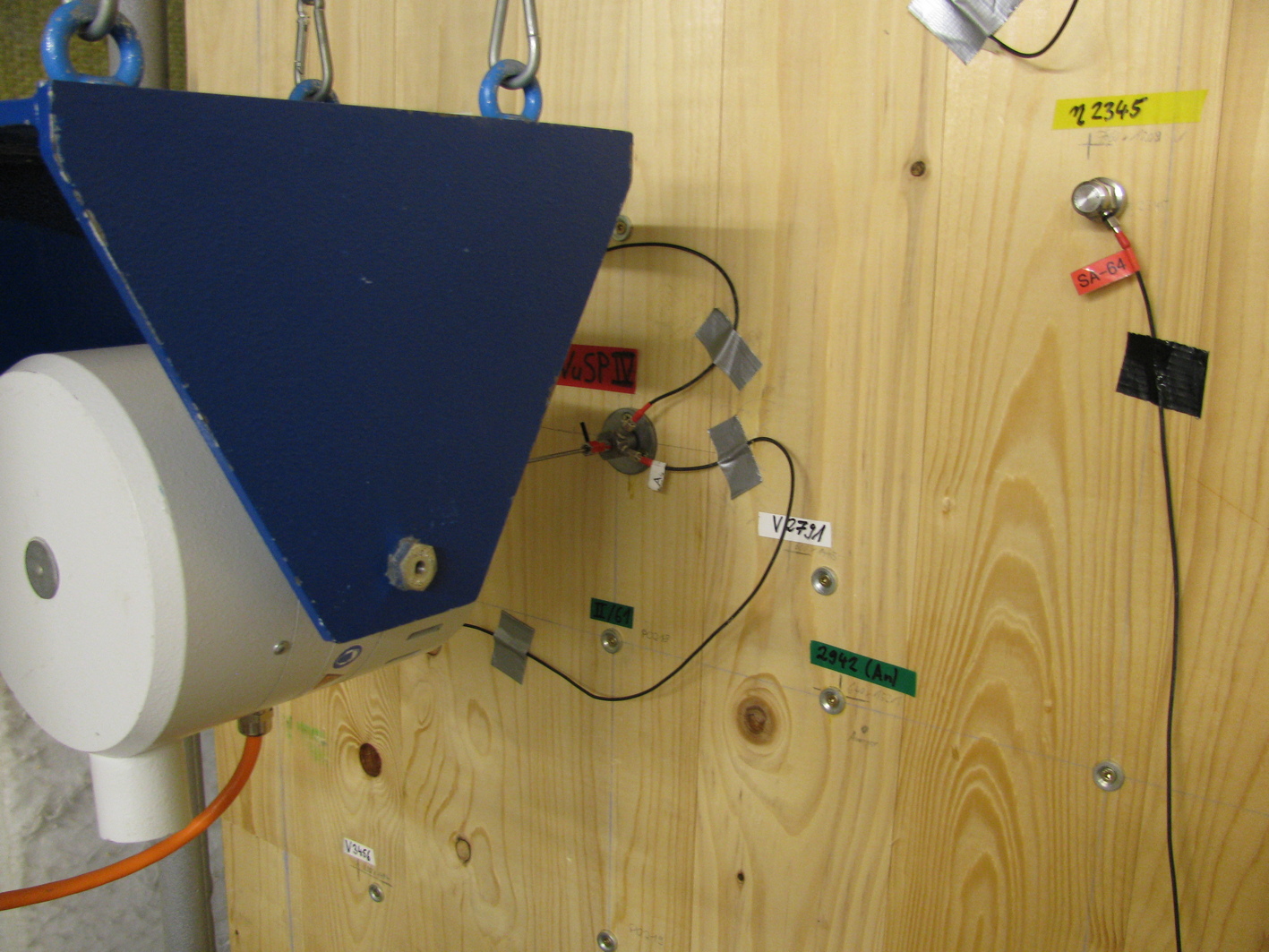
The aim of the project is a planning process that closely links the numerical simulation and verification of vibroacoustic building properties to a comprehensive building information model (BIM).
Project background
In recent years, numerous studies have already been carried out at Rosenheim University of Applied Sciences on sound insulation in timber construction. For this purpose, the vibration behavior of modern timber ceiling systems in the range below 100 Hz, which is dominant for sound transmission in timber construction, was investigated in particular.
In the project, typical joints of modern timber construction systems are investigated in particular by measurement and calculation. The measured values are used to validate simulation models. The frequency range relevant to building acoustics is calculated using two different, complementary models. In the low-frequency range, FEM models from the Technical University of Munich are used. For the medium and higher frequency range, simulation models based on statistical energy analysis are being developed at Rosenheim University of Applied Sciences.
The findings should help to significantly improve the predictive reliability of sound insulation in timber construction at an early stage of the planning process and thus increase the competitiveness of timber construction compared to solid construction.
Project objective
The aim of the project is a planning process that closely links the numerical simulation and verification of vibroacoustic building properties to a comprehensive building information model (BIM). This enables the specialist planner to optimize the design of individual components, investigate their (vibration-related) coupling and the vibroacoustic properties of the entire building at an early planning stage.
In combination with the Statistical Energy Analysis (SEA) method, the aim is to extend existing finite element methods with regard to the geometric-mechanical and vibroacoustically consistent coupling of components and to derive the volume-oriented overall model from the building information model.
Innovation
The challenge of the research focus at Rosenheim University of Applied Sciences is to calculate the propagation of structure-borne sound via standard construction joints and to reduce the variety of construction variants in modern timber construction to a few standard constructions with similar acoustic behavior.
Rabold, Andreas; Châteauvieux-Hellwig, Camille; Mecking, Simon; Schramm, Markus (2019)
Inter Noise 2019 Madrid 48th International Congress and Exhibition on Noise Control Engineering.
Flanking transmission of solid wood elements in multi-storey timber buildings - Input data and prediction models for airborne and impact sound excitation -
Mecking, Simon; Schoenwald, Stefan; Schanda, Ulrich (2018)
Proceedings of Euronoise.
Material characterisation of Cross Laminated Timber using experimental wave velocities
Rabold, Andreas; Châteauvieux-Hellwig, Camille; Mecking, Simon (2018)
Fortschritte der Akustik - DAGA.
Nachweis von Holzdecken nach DIN 4109 - Möglichkeiten und Grenzen
Rabold, Andreas; Winter, Christoph; Schanda, Ulrich; Kollmannsberger, Stefan; Rank, Ernst; Müller, Gerhard; Horger, Thomas; Wohlmuth, Barbara; Frischmann, Felix; Paolini, Alexander; Schramm, Markus; Châteauvieux-Hellwig, Camille; Buchschmid, Martin; Kruse, Tobias; Mecking, Simon (2018)
Rabold, Andreas; Winter, Christoph; Schanda, Ulrich; Kollmannsberger, Stefan...
Unpublished.
Vibroakustik im Planungsprozess für Holzbauten - Modellierung, numerische Simulation, Validierung: Dachbericht zum Forschungsvorhaben
DOI: 10.13140/rg.2.2.28337.24160
Mecking, Simon; Kruse, Tobias; Winter, Christoph; Schanda, Ulrich (2017)
, Online-Ressource.
Vibroakustik im Planungsprozess für Holzbauten - Modellierung, numerische Simulation, Validierung, Teilprojekt 3: Parameterentwicklung und SEA-Modellierung, Schlussbericht
Open Access
Mecking, Simon; Kruse, Tobias; Winter, Christoph; Schanda, Ulrich; e.V., Internationaler (2017)
Mecking, Simon; Kruse, Tobias; Winter, Christoph; Schanda, Ulrich...
Vibroakustik im Planungsprozess von Holzbauten - Modellierung, numerische Simulation, Validierung: AiF 17328 N
Paolini, A; Kollmannsberger, S; Winter, C; Buchschmid, M; Müller, Gerhard; Rabold, Andreas; Mecking, Simon; Schanda, Ulrich; Rank, E (2017)
Paolini, A; Kollmannsberger, S; Winter, C; Buchschmid, M; Müller, Gerhard...
Building Acoustics 24, 135-158.
A high-order finite element model for vibration analysis of cross-laminated timber assemblies
DOI: 10.1177/1351010X17727126
Timpte, Aline; Mecking, Simon; Schanda, Ulrich; Rabold, Andreas (2017)
Fortschritte der Akustik - DAGA.
Stoßstellendämm-Maße von Brettsperrholzkonstruktionen
Timpte, A; Mecking, Simon; Schanda, Ulrich; Rabold, Andreas (2017)
24th International Congress on Sound and Vibration Icsv 2017.
Vibration reduction indices of CLT junctions
Rabold, Andreas; Cĥateauvieux-Hellwig, Camille; Mecking, Simon (2017)
8. HolzBauSpezial.
Optimierung von Holzdecken in Bezug auf die DIN 4109
Mecking, Simon; Scheibengraber, M; Kruse, Tobias; Schanda, Ulrich; Wellisch, Ulrich (2017)
24th International Congress on Sound and Vibration Icsv 2017.
Experimentally based statistical analysis of the vibrational energy of CLT building elements
Haut, Sandra; Mecking, Simon; Schanda, Ulrich (2017)
Fortschritte der Akustik - DAGA.
Experimentelle Bestimmung des Abstrahlgrades und des inneren Verlustfaktors orthotroper Platten
Mecking, Simon; Scheibengraber, Markus; Kruse, Tobias; Schanda, Ulrich; Wellisch, Ulrich (2017)
Mecking, Simon; Scheibengraber, Markus; Kruse, Tobias; Schanda, Ulrich...
Fortschritte der Akustik - DAGA.
Energiebestimmung an Brettsperrholzbauteilen im Holzmassivbau
Cĥateauvieux-Hellwig, Camille; Mecking, Simon; Brummer, Benjamin; Rabold, Andreas (2016)
Fortschritte der Akustik - DAGA.
Anwendung zur SEA basierten Berechnung nach EN~12354 für Massivholzelemente
Mecking, Simon; Kruse, Tobias; Châteauvieux-Hellwig, Camille; Schanda, Ulrich (2016)
Fortschritte der Akustik - DAGA.
Körperschallfelder in Brettsperrholzbauteilen des Holzmassivbaus
Schanda, Ulrich; Mecking, Simon; Winter, Christoph (2015)
, xi, 235 Seiten.
Vibroakustik im Planungsprozess für Holzbauten - Modellierung, numerische Simulation, Validierung - Teilantrag 3: Parameterentwicklung und SEA-Modellierung
Mecking, Simon; Kruse, Tobias; Schanda, Ulrich (2015)
Fortschritte der Akustik - DAGA.
Messung und Berechnung der Körperschallübertragung am Bauteilstoß von Massivholzelementen
Mecking, Simon; Kruse, Tobias; Schanda, Ulrich (2015)
Euronoise 2015, 21-26.
Measurement and calculation of sound transmission across junctions of solid timber building elements
Mecking, Simon (2014)Bauteilstöße im Holzmassivbau: Messtechnische Bestimmung von Eingangsgrößen für eine Schallschutzprognose
Open Access
Winter, C; Buchschmid, M; Mecking, Simon; Weineisen, C; Müller, Gerhard; Schanda, Ulrich (2014)
Winter, C; Buchschmid, M; Mecking, Simon; Weineisen, C; Müller, Gerhard...
Proceedings of the International Conference on Structural Dynamic Eurodyn, 3265-3271.
Modelling the sound transmission across junctions of building components by energy influence coefficients
Winter, Christoph; Buchschmid, Martin; Mecking, Simon; Müller, Gerhard; Schanda, Ulrich (2014)
Winter, Christoph; Buchschmid, Martin; Mecking, Simon; Müller, Gerhard...
Fortschritte der Akustik - DAGA.
Ein hybrider FEM/SEA Ansatz zur Prognose der Schallübertragung an Bauteilstößen
Mecking, Simon; Völtl, Raphael; Winter, Christoph; Buchschmid, Martin; Schanda, Ulrich; Müller, Gerhard (2014)
Mecking, Simon; Völtl, Raphael; Winter, Christoph; Buchschmid, Martin; Schanda, Ulrich...
Fortschritte der Akustik - DAGA.
Methodenvergleich zur Bestimmung von Verlustfaktoren von Massivholzelementen
Sub-project lead
T +49 (0) 8031 / 805 - 2407 Ulrich.Schanda[at]th-rosenheim.de
ORCID iD: 0009-0008-3988-9288
Project staff
T +49 (0) 8031 / 805 - 2588 Tobias.Kruse[at]th-rosenheim.de
ORCID iD: 0009-0008-7958-1560
T +49 (0) 8031 / 805 - 2582 simon.mecking[at]th-rosenheim.de
ORCID iD: 0009-0000-6835-9237
Project duration
2015-04-01 - 2017-03-31Project partners

Project management agency
Project funding

Funding programme
Industrielle GemeinschaftsforschungSustainable Development Goals