
Scene change between kitchen and living room
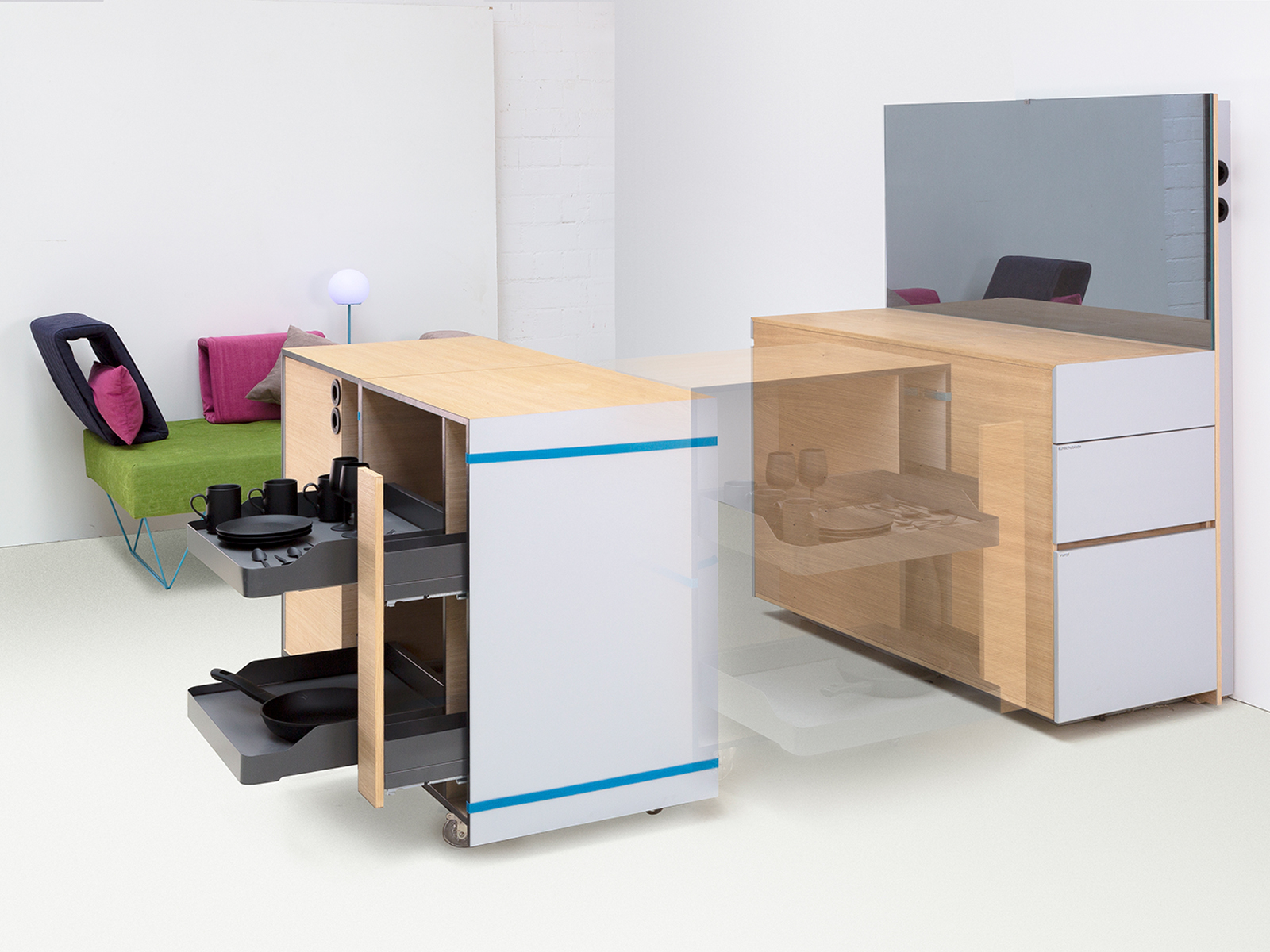
In modern layouts with open-plan kitchens, both the living room and the kitchen are under pressure to vary and transform. Both rooms or zones oscillate back and forth between two extremes. When there is no cooking, as little of the kitchen as possible should be visible and the room should be an extended living room. When cooking and eating, the kitchen must be able to be activated over a large area and part of the living room must mutate into a dining room. There is a lack of solutions for this area in high-density living.

Project background
The kitchen and living area have diametrically different characteristics: The living area is textile and upholstery-oriented, serves passive use, has predominantly open, representative storage space and subdued, differentiated reading and mood lighting. The kitchen, on the other hand, is characterized by hard, hard-wearing surfaces that do not absorb moisture and odours, serves active use, has predominantly closed, function-oriented storage spaces and bright, shadow-free working light.
How can a functional and aesthetic bridge be built between these two areas in the future? Do we need convertible furniture (transformers)? Flexible parasites (add-ons)? Or foldable solutions (foldables)? How can this zone be designed to optimize storage space in the future? How can new storage space be created?
Project objective
How can a functional and aesthetic bridge be built between these two areas in the future? Do we need convertible furniture (transformers)? Flexible parasites (add-ons)? Or foldable solutions (foldables)? How can this zone be designed to optimize storage space in the future? How can new storage space be created?
Innovation
In this research project, new solutions were developed that strengthen the potential of this transition zone and bring aesthetic and functional improvement.