Fluid Dynamics Simulation and Experimental Development of the Optimal Design Geometry for a New Hydrocyclone with an Integrated Deflector Wheel
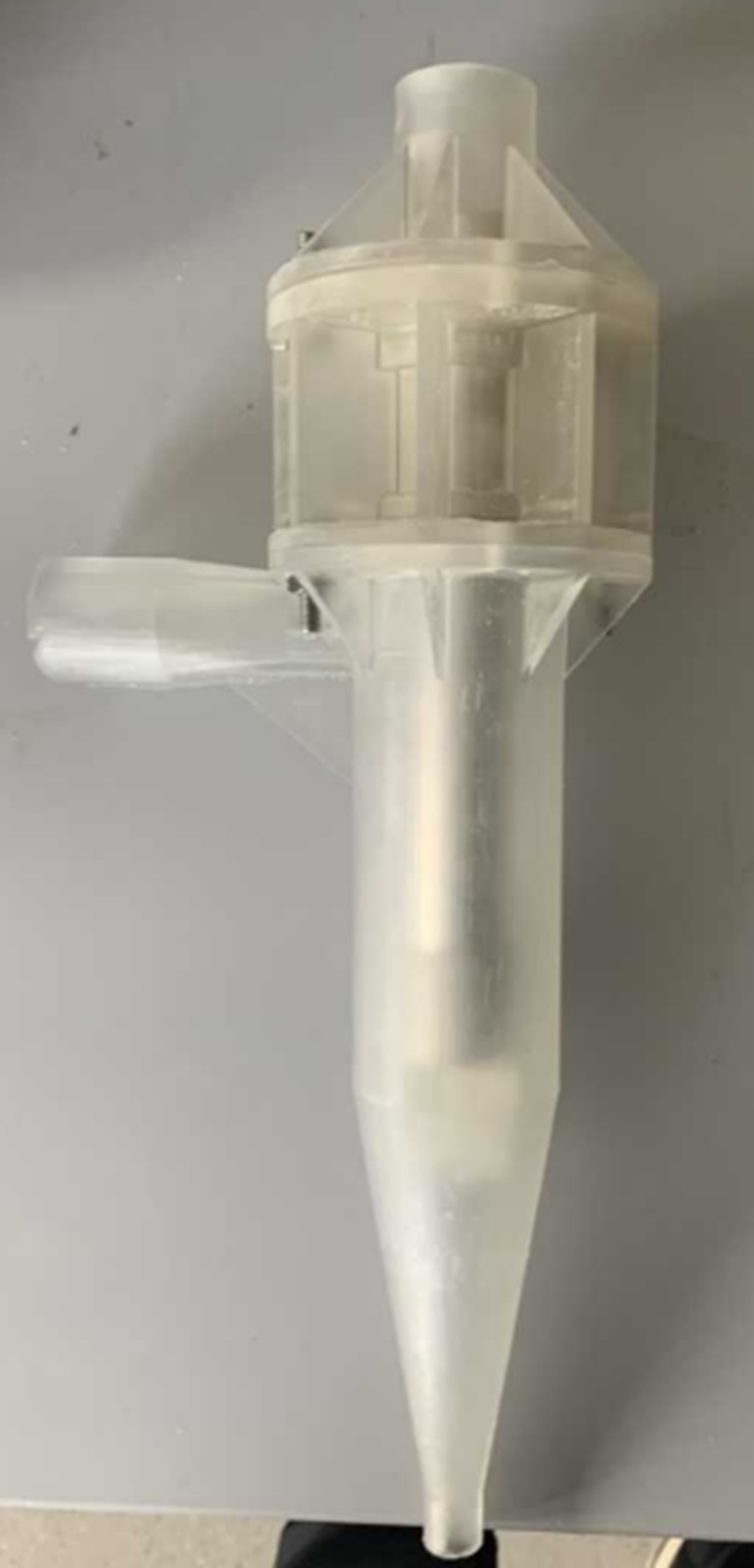
Conventional hydrocyclones use the energy of the flowing fluid to create a vortex and separate low-concentration particles using centrifugal forces. The goal of the project is to develop a drive system that will increase separation efficiency with minimal effort, separate finer particles, and enable separation even at high solids loads.
Project background
Conventional hydrocyclones are primarily used to separate impurities from liquids; however, when dealing with high solids loads or stringent requirements, significantly more expensive centrifuges are used due to their superior separation efficiency and ability to separate solids at high concentrations.
Project objective
The goal is to improve the separation efficiency of hydrocyclones and to make them suitable for use even at high solids loads. The design will incorporate a dedicated outlet that reduces turbulence during separation and can also provide additional energy.
Project procedure
First, different outlet geometries are simulated using flow simulation. At the same time, initial tests are being conducted in the laboratory on cyclones produced using rapid prototyping, which feature a special outlet geometry. Following a parametric study, the goal is to develop an optimal geometry to improve operational performance with minimal additional effort.
Innovation
The innovative aspect lies in the development of a hydrocyclone with a separate drive and a dedicated, movable outlet geometry. There are currently no variations of this design. This provides a significantly more cost-effective alternative to much more expensive centrifuges, which is expected to make various manufacturing processes significantly cheaper.
Project lead
Project staff
T +49 (0) 8031 / 805 - 2878 tzu-yang.huang[at]th-rosenheim.de
ORCID iD: 0009-0003-4399-6848
T +49 (0) 8031 / 805 - 2943 benedikt.schwarz[at]th-rosenheim.de
ORCID iD: 0009-0003-1395-6423
External project collaboration
Wolftechnik Filtersysteme GmbH & Co. KG
AiF Projekt GmbH
Project duration
2026-08-01 - 2029-03-31Project partners
Project management agency

Project funding
Funding programme
Zentrales Innovationsprogramm Mittelstand