Development and evaluation of suitable surface textures to enhance the sound absorption of clay-based building products for rooms with specific acoustic requirements

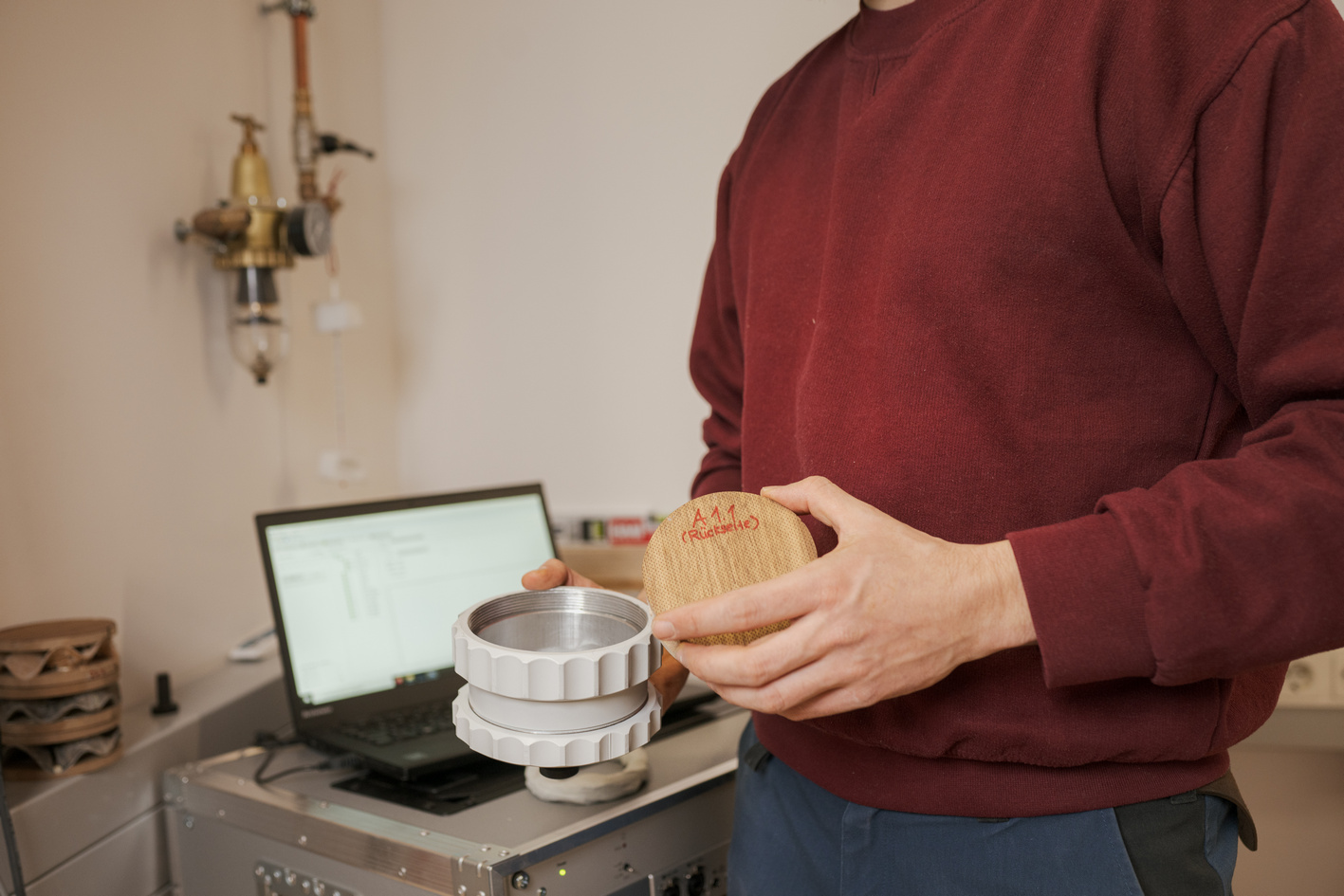
The project aims to make clay usable in these demanding applications through targeted investigations and surface modifications, so that the ecological benefits of clay can be more widely exploited.
Project background
With the gradual phasing out of coal-fired power generation, the secondary raw material FGD gypsum (flue gas desulphurization gypsum), which was previously relevant in terms of volume and is primarily used for the production of conventional plasterboard in drywall construction (50% of 11 million tonnes of gypsum raw material per year), is increasingly being phased out. As a result, pressure on the extraction of natural gypsum is increasing, which must be viewed critically in view of ecological and social resistance - for example due to land consumption or encroachment on sensitive landscapes. This development is increasing the demand for resource-saving, sustainable building materials for interior construction with comparable technical performance. Clay building products offer a sustainable alternative here. There are established solutions for room acoustics for plasterboard. However, specific solutions for sound absorption in interiors need to be developed for earth building products.
Project objective
The aim of the project is to develop surface structures that specifically improve the sound absorption behavior of earth building panels. This should also make earth building products suitable for rooms with increased acoustic requirements, such as offices, schools and nurseries.
Project procedure
In order to improve the sound absorption behavior of clay building panels, suitable geometric modifications of the surface are to be identified and their influence on the acoustic properties systematically investigated. Parameter studies will be used to quantitatively evaluate the effects of selected geometric parameters and their combinations on sound absorption. The aim is to derive correlations that enable an evaluation of the effectiveness depending on the structure-related characteristics. In addition to the acoustic properties, the effects of the structures on the mechanical properties are investigated in parallel.
Innovation
The overarching aim is to develop a heat-storing, hygroscopic and acoustically effective interior construction panel that can passively regulate temperature, humidity and sound. The planned investigations create the necessary scientific and technical basis for such a multifunctional, resource-efficient interior finishing panel with clay content and integrated wall and ceiling heating. This eliminates the need for additional technical components such as radiators, sound absorbers or systems to regulate the indoor climate.
This opens up considerable potential for reducing structural complexity and installation costs, particularly in renovation projects. The parametric analysis of the sound absorption capacity of different surface structures and geometries is used to systematically develop correlations between surface structure and sound absorption behavior for clay products. These form the basis for a novel, industrially applicable manufacturing process for functionalized clay surfaces.
Project lead
T +49 (0) 8031 / 805 - 2407 Ulrich.Schanda[at]th-rosenheim.de
ORCID iD: 0009-0008-3988-9288
Project staff
T +49 (0) 8031 / 805 - 2345 robin.hierl[at]th-rosenheim.de
T +49 (0) 8031 / 805 - 2483 Peter.Werndl[at]th-rosenheim.de
bernhard.zarnitz[at]th-rosenheim.de
External project collaboration
Lehmputz Trockenbausysteme GmbH & Co KG
Project duration
2025-12-11 - 2027-02-11Project partners
Funding programme
Deutsche Bundesstiftung UmweltSustainable Development Goals