
Generalizable AI for Process Optimization Using Models That Characterize Process Phases
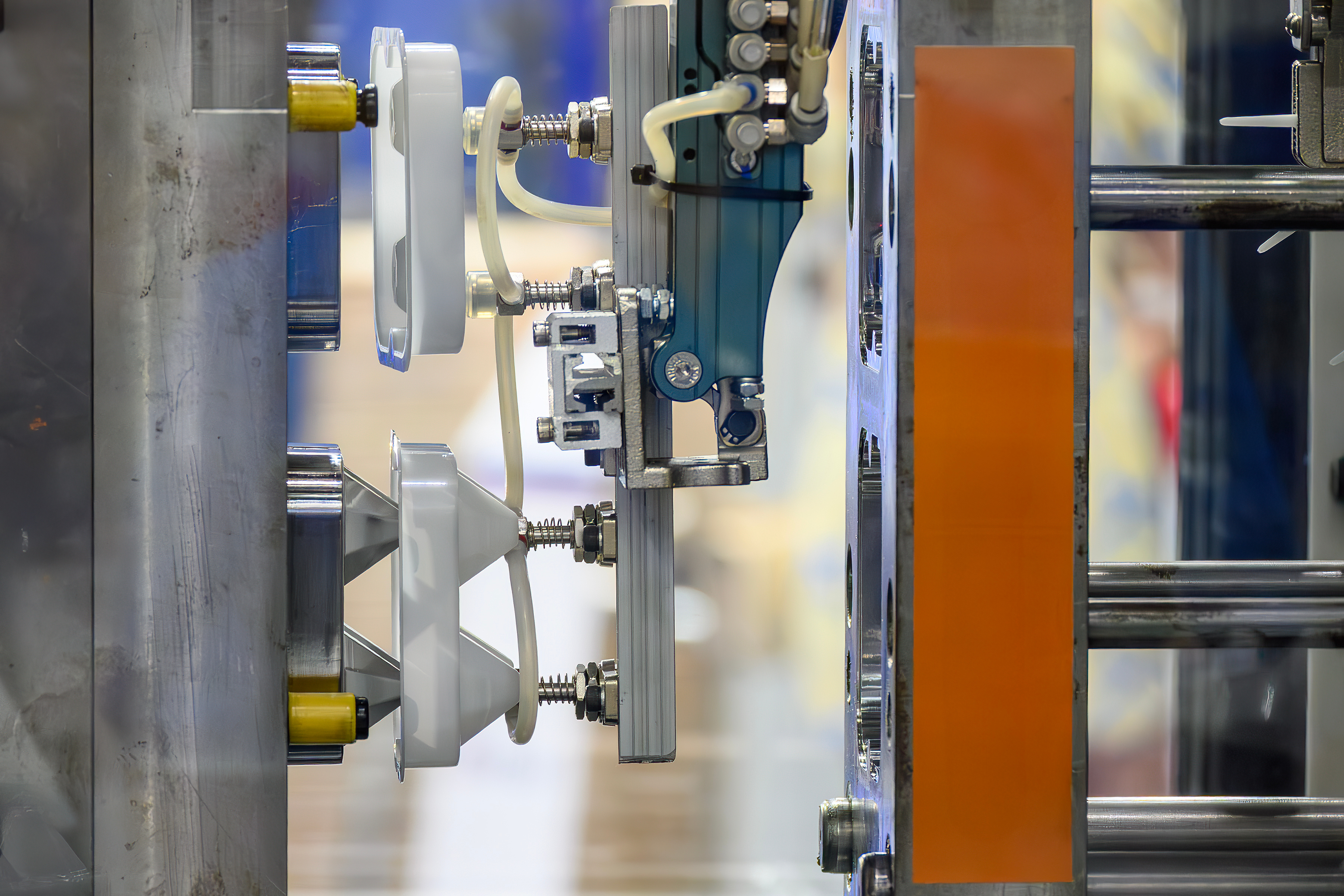
Process data (trends) from individual production cycles are used to predict the quality of individual components. Dividing the cycle into phases is intended to increase its transferability to new applications and open up further possibilities through the analysis of individual process phases.
Project background
To increase production efficiency, the industry requires stable processes and rapid—preferably early—defect detection. By analyzing process data, component quality can be predicted. On the one hand, this enables defect detection even before the subsequent quality control check, thereby allowing the production of defective parts to be halted. On the other hand, it offers the possibility of identifying the cause of the defect within the process. To this end, this research examines approaches for evaluating component quality based on time-resolved process variables of the cycle, such as the injection pressure profile and screw movement. The individual phases of the process are considered separately in order to independently evaluate the melting of the material, the injection and filling of the part, and the post-injection to compensate for shrinkage. This yields phase-specific models that, together, provide an overall evaluation of the part. The architecture of this approach enables the direct assignment of the cause of defects to the individual process phases and thus supports the elimination of potential causes of defects in a much more targeted manner. Furthermore, this phase-specific approach makes it possible to restrict the relationships between the control parameters and the resulting process variables to the corresponding control parameters during each phase. This allows these relationships to be learned and, consequently, synthetic data to be generated. Consequently, control parameters could be used to generate process curves without the need to manufacture components, and these curves can in turn be used for quality assessment. This is intended to enable resource-efficient process optimization in the digital domain.
Project objective
The project objective is to increase efficiency by reducing the amount of training data required and improving the transferability of the models to different machines and processes. A key aspect is the generation of the time-series data required for AI training as synthetic data, thereby enabling the creation of application-specific, realistic process sequences in the digital space. Since a reliable AI model benefits from a heterogeneous data set that does not consist solely of good parts, these approaches offer the possibility of simulating data from scrap parts in the digital space without straining real production capacities.
Project procedure
The injection molding process can be divided into phases that can be considered and evaluated independently of one another. Each phase establishes the initial conditions for the subsequent phases, so that information from individual phases influences the evaluation of the following ones. The injection molding process and the associated data are therefore divided into phases.
These phases are analyzed by standardizing and normalizing process curves and features to ensure transferability across different manufacturing processes.
Targeted test series are conducted to evaluate the normalized process curve profiles and assign labels for AI training. In this process, individual phases as well as multiple phases are deliberately manipulated to create a homogeneous data set.
Features and key metrics are extracted from the process curves. These features are also intended to help understand the decision-making basis of the AI models and to detect any errors at an early stage. To this end, these features are evaluated using the project partners’ expert knowledge. This data serves as supplementary validation for the AI models. Figure 1 illustrates a workflow for phase evaluation.
Phase-specific AI models are trained, tested, and validated. In addition to the phase-specific models, a combination of these models is created to provide a comprehensive evaluation of the process. Furthermore, strategies for continuous improvement and the generation of AI models are being developed based on conscious and unconscious inputs from operators working on running machines.
To round out these activities, approaches for generating realistic synthetic data are being developed. Thanks to the phase breakdown and normalization, the complexity of the injection molding process can be broken down. This allows for a more targeted analysis and replication of the relationships between setup parameters and resulting process variables. The generation of synthetic data, as well as its functionality as a substitute or supplement to real data for training AI models, is being examined and evaluated.
Innovation
In the SelbstSGKI project, AI models were trained on the entire set of process data from a single cycle (corresponding to the manufacture of a component). In this proposed project, the process will additionally be divided into phases and standardized and normalized. This subdivision offers the potential for more specific AI models as well as the possibility of better transferability through more representative normalization. This is because not all information is necessary for every process phase. For example, the clamping force has no added value during the dosing phase; however, it can vary during dosing, which can lead to an erroneous correlation. This phase subdivision enables the development of more specific AI models, as only the process variables with information relevant to the respective phase are considered.
The creation of synthetic datasets to model real-world process sequences represents a significant advance. This makes it possible to digitally simulate and optimize the injection molding process in an energy- and resource-efficient manner, as it reduces the need for scrap production to generate training data. Synthetic data offers the possibility of modeling and understanding complex process conditions without straining real production capacities.
The development of methods for standardizing and normalizing features contributes significantly to increasing the efficiency and transferability of AI models. The resulting comparability is shown in Figure 2 and is particularly necessary for machine-based analyses.
The approach of continuously refining models through conscious and unconscious user interaction represents a significant advance in the adaptive learning capabilities of AI systems.
Project lead
T +49 (0) 8031 / 805 - 2631 Peter.Karlinger[at]th-rosenheim.de
ORCID iD: 0009-0002-8523-3630
Project staff
T +49 (0) 8031 / 805 - 2637 Christian.Bielenberg[at]th-rosenheim.de
ORCID iD: 0009-0006-8396-9926
T +49 (0) 8031 / 805 - 2590 georg.rottenwalter[at]th-rosenheim.de
ORCID iD: 0009-0000-8612-3623
External project collaboration
VDI / VDE Innovation + Technik GmbH
Sumitomo (SHI) Demag Plastics Machinery
Project duration
2026-02-01 - 2029-01-31Project partners
Project management agency
Project funding
