
Data-based modeling of building energy systems using transfer learning
Transfer learning with simulated building data to develop data-efficient, reusable models for building energy systems and their control
Project background
Sensor data-based building modeling forms a central basis for the extensive automation of modern applications in building energy systems, such as advanced control processes (e.g. model predictive control or reinforcement learning) and load forecasts.
However, there are significant challenges in the practical application of data-based models. These include, in particular, the low data efficiency of many data-driven methods, the associated long period of time required to collect sufficient measurement data in real buildings and the limited reusability of models for different building types. To overcome these hurdles, data-driven methods are being developed that make do with as little real measurement data as possible and at the same time enable transferable models.
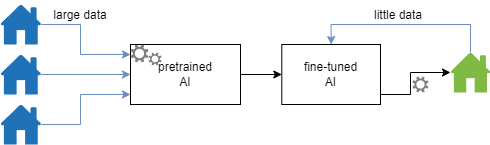
A promising approach for this is the use of transfer learning methods, in particular the pre-training and fine-tuning strategy, in which models are first pre-trained on extensive simulated building data and then adapted to specific buildings using a small amount of real measurement data.
Project objective
The aim of the project is to prove the feasibility (proof of concept) for the pretraining of reusable transfer learning models based on large volumes of simulated building data. The aim is to investigate the extent to which data efficiency can be improved compared to purely data-driven approaches and how much the need for real measurement data can be reduced.
In addition, the extent to which the pre-trained models can be transferred to different buildings will be analyzed. As a contribution to the energy transition, the methodological approaches developed will be evaluated using a residential building with a heat pump, solar thermal energy and thermal storage using both simulated and real data.
Project procedure
In the project, extensive synthetic data sets are first generated using building simulations that map various building configurations, usage profiles, locations and energy systems. Based on this simulated data, data-driven models are trained as part of a pre-training step in order to learn general relationships of the thermal building energy system. These pre-trained models are then fine-tuned using a limited amount of real measurement data from a specific reference building. The performance of the transfer learning approaches is evaluated in terms of data efficiency and prediction quality.
In addition, the extent to which the pre-trained models can be transferred to other buildings will be investigated. The evaluation is carried out both in simulation and using real measurement data from a residential building with a heat pump, solar thermal system and thermal storage system.
Innovation
The innovation of the project lies in the combination of transfer learning with large-scale pre-training on synthetic building data to develop reusable models for building energy systems. This significantly reduces the need for real measurement data, which is costly and time-consuming to collect, thus considerably accelerating the practical introduction of data-driven methods in buildings. At the same time, the approach enables the transferability of models between different buildings, creating economies of scale and reducing development costs.
If the project is successfully completed, the building and energy technology sector, manufacturers of building automation systems and planning and energy service companies will benefit in particular. In addition, the approach contributes to the more efficient use of renewable energies, improved operational management of heat pump and storage systems and the flexibilization of loads, thus contributing to the integration of renewable energies and the implementation of the energy transition.
Project lead
T +49 (0) 8031 / 805 - 2885 benjamin.tischler[at]th-rosenheim.de
ORCID iD: 0000-0002-6274-8036
Sub-project lead
Project staff
T +49 (0) 8031 / 805 - 2752 Dominik.Aimer[at]th-rosenheim.de
ORCID iD: 0009-0002-4580-577X
External project collaboration
Bundesinstitut für Bau-, Stadt- und Raumforschung
Project duration
2024-09-16 - 2026-09-15Project partners

Project management agency

Project funding
Funding programme
Innovationsprogramm Zukunft Bau