
VibWood: Development of planning aids for the acoustic and vibration description of wooden ceilings in multi-storey residential and commercial buildings

Development of planning aids for the sound and vibration and vibration description of wooden ceilings in multi-storey residential and residential and commercial buildings in the frequency range below 100 Hz as well as for the evaluation and dimensioning of adapted vibration protection systems
Project background
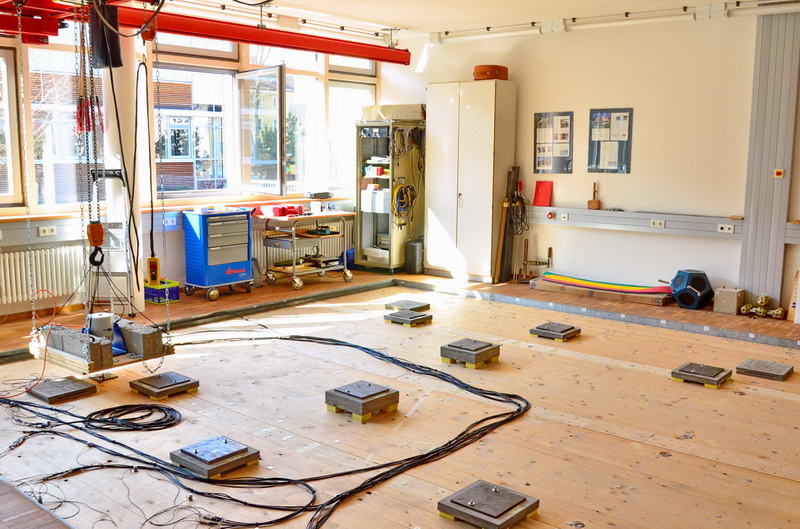
In recent years, the Rosenheim University of Applied Sciences has already extensive investigations into low-frequency vibrations and their eradication in the context of carried out as part of diploma and master's theses. The project is the continuation of these investigations with the aim of preparing the results for practical in a practical way. The content consists of metrological investigations of various wooden ceiling systems and the development and measurement of
In the course of the project, the measured structures are simulated in parallel at the TU Munich using FEM models. Munich with the help of FEM models. This provides the This makes it possible to investigate variations in the ceiling with relatively little simulations with relatively little effort and to adjust the measurement accordingly.
Project objective
The aim is to develop simple planning aids for evaluating the vibration-related properties of wooden ceilings are to be developed. Furthermore Vibration protection systems and their dimensioning will be investigated which can be used to reduce vibrations in the range below 100Hz. These can be, for example, specifically used vibration absorbers, or also appropriately designed suspended ceilings or floating screed structures.
Innovation
The main challenge is to understand the complex relationships between the between the vibration behavior of the ceiling and its causes to as few parameters as possible as few parameters as possible in order to ultimately develop simple and yet develop simple yet reliable planning aids.
Sub-project lead
T +49 (0) 8031 / 805 - 2407 Ulrich.Schanda[at]th-rosenheim.de
ORCID iD: 0009-0008-3988-9288
Project duration
2010-11-01 - 2014-03-31Project partners

Project funding

Sustainable Development Goals