
Prediction method for noise and vibration protection for BIM-based building planning

Research focus
Forecasting methods for noise and vibration protection for BIM-based building planning - continuation and extension to methods of artificial intelligence
Project background
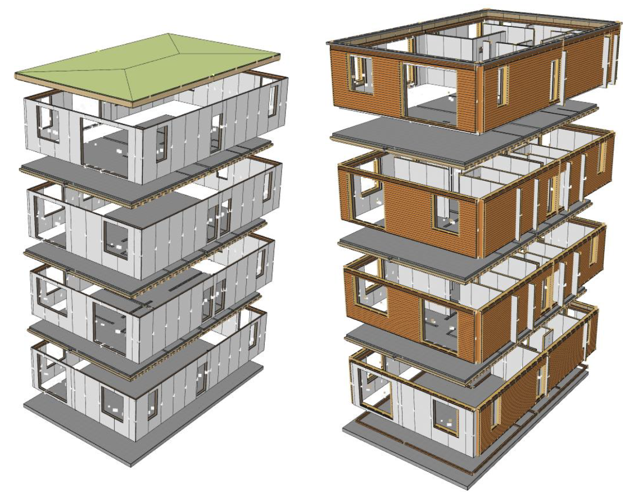
Timber construction timber construction is on the rise, also in the area of multi-storey new buildings. With regard to compliance with fire protection regulations for multi-storey buildings, timber constructions have already been intensively and optimized. With regard to the legally required noise protection, however, there is still a great deal of uncertainty among planners uncertainty in the forecast calculation, both for airborne and impact sound transmission. as well as for impact sound transmission. Structural verification in accordance with the required DIN is not yet possible for many timber construction methods. This This also applies to the verification of sound insulation for building services
Timber constructions stand for a high quality of construction, planning and living, taking into account all aspects of sustainability. Against this background, the Rosenheim Technical University of Applied Sciences has established and now extended the research focus "Prediction methods for sound and vibration protection for BIM-based building planning". The aim is to develop reliable prediction models for building acoustics that focus on sound and vibration protection in timber construction and structure-borne noise from technical building systems. Digital processes and methods such as BIM and AI are also used in the process.
Project objective
The planning-relevant topic will also be discussed in with regard to the digitalization of the construction process using Building Information Modeling (BIM) is considered. The innovative approach of BIM opens up the possibility of using model-based calculation results for a complete noise protection forecast and for compliance with the requirements requirements during the planning process and thus save costs and avoid errors. save costs and avoid errors. These forecasting methods are subject of scientific discussion at both national and international international level, which is supported by the cooperation of the Rosenheim in the European standardization committees. And The regional focus on digital building planning also offers offers many opportunities for the establishment of new start-up companies.
Project coordinator
T +49 (0) 8031 / 805 - 2532 Andreas.Mayr[at]th-rosenheim.de
ORCID iD: 0000-0003-2843-1825
Project lead
T +49 (0) 8031 / 805 - 2407 Ulrich.Schanda[at]th-rosenheim.de
ORCID iD: 0009-0008-3988-9288
Sub-project lead
Project staff
T +49 (0) 8031 / 805 - 2479 Camille.Chateauvieux-Hellwig[at]th-rosenheim.de
ORCID iD: 0009-0006-5093-3054
T +49 (0) 8031 / 805 - 2589 Fabian.Schoepfer[at]th-rosenheim.de
ORCID iD: 0009-0000-2809-2953
Project duration
2018-01-01 - 2022-06-30Project funding

Funding programme
Programm zur Förderung der angewandten Forschung und Entwicklung an Hochschulen für angewandte Wissenschaften - Fachhochschulen
Sustainable Development Goals

