Development of a technology for processing paper pulp into complex three-dimensional, eco-friendly, and recyclable components using injection molding
Development of sustainable, innovative paper components made from renewable raw materials, recyclable, and designed to replace plastic
Project background
The growing pressure from climate change, declining availability of raw materials, and the environmental impact of plastics call for new, sustainable material solutions. At the same time, demand is growing for products that conserve resources and are recyclable. Against this backdrop, the project aims to develop an innovative paper material and a novel injection molding technology for the production of high-quality technical paper components.
Cellulose-based paper offers great potential for this purpose. It is made from domestic and renewable raw materials, has established recycling infrastructure, and is biodegradable. However, existing paper forming processes reach their limits when dealing with complex geometries and high requirements for strength and dimensional accuracy. In addition, existing paper-based injection-molded products often fail to achieve the desired properties or contain plastic components that limit their recyclability.
Project objective
The project aims to develop an innovative, sustainable paper material as well as a novel injection molding process to produce high-quality, defect-free paper components with complex geometries. The goal is to validate the new material using a technical demonstrator component that has previously been manufactured exclusively from plastic and cannot be produced using conventional paper forming processes.
Furthermore, the use of sustainable raw materials and integration into existing paper recycling loops is intended to contribute to the circular economy. In addition to developing high-performance material and tooling solutions, the project focuses on improving the mechanical properties of paper components and investigating the environmental and economic advantages over conventional plastic solutions.
Project procedure
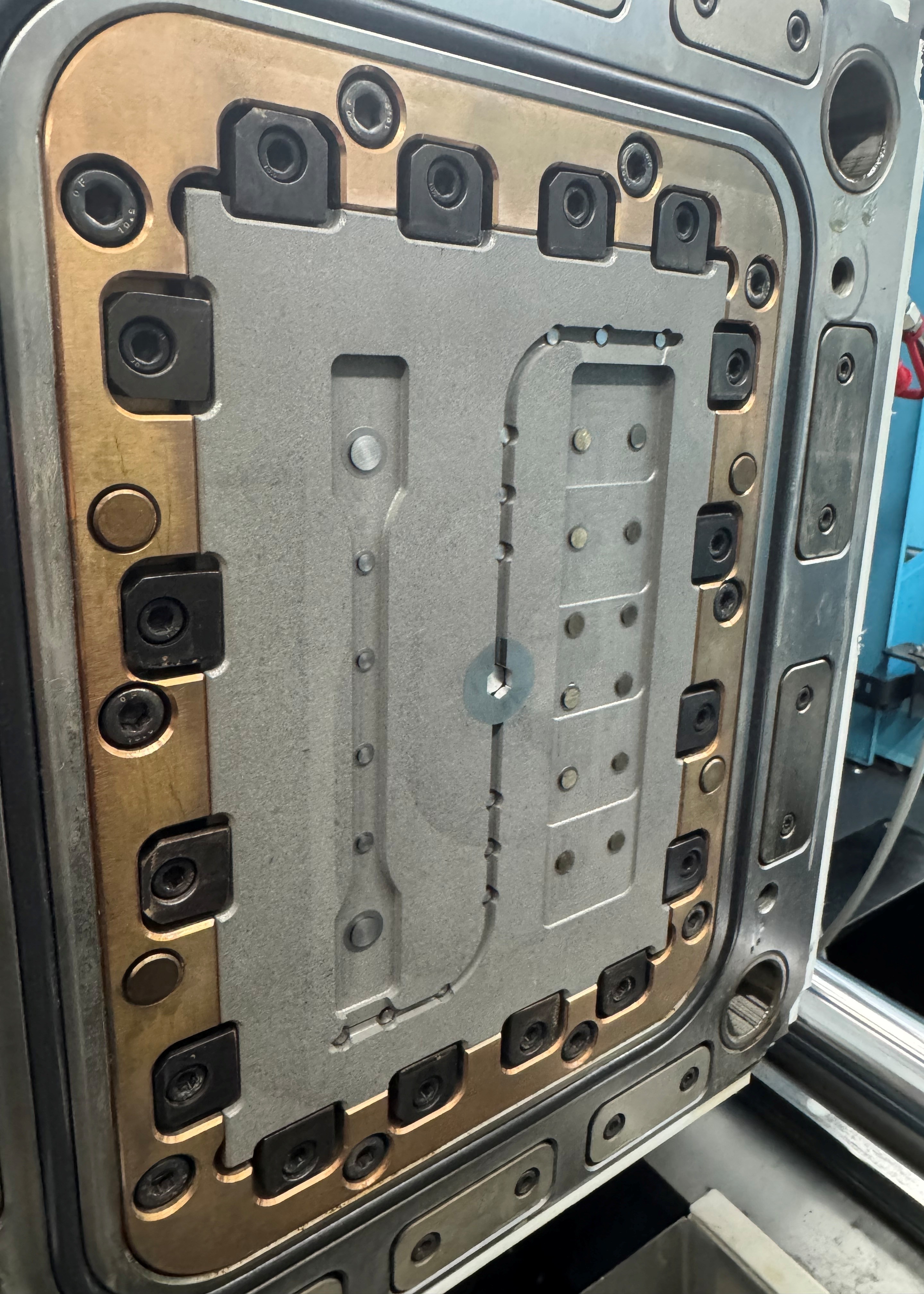
The project will first develop paper-based materials and adapt them to technical requirements through targeted formulation adjustments. Subsequently, suitable dosing and injection molding processes, as well as an innovative tool for the efficient drying of the components, will be developed and tested.
The manufactured paper components will be examined for their mechanical properties and process quality and gradually optimized. Based on these findings, a demonstrator component will be developed and manufactured. Finally, the environmental and economic potential of the new material and process will be evaluated in comparison to plastic solutions.
Innovation
The project takes a novel approach to the production of technical paper components. Instead of using paper merely for simple molded parts, application-specific paper components are being developed for the first time using injection molding—components that can meet high standards for strength, dimensional accuracy, and functionality.
The innovation lies in the combination of a high-fiber paper material with biological strength additives, the targeted adaptation of the material formulation to specific applications, and the development of an innovative injection molding tool for efficient drying and reliable production of complex components. Through material characterization and simulation, the geometry and material properties can be specifically tailored to the respective application.
Unlike existing paper-based injection molding solutions, no plastic matrices are used, and the additive content remains low. This results in high-quality paper components that can be fully recycled within the existing paper recycling stream.
At the same time, the high fiber content enables improved mechanical properties and lower energy consumption during production.
The successful completion of the project establishes a new technology platform for sustainable technical components. This platform can replace plastic solutions in various industries, such as household goods, electrical engineering, medicine, and the automotive industry. As a result, the economy and society benefit from resource-efficient, recyclable, and high-performance alternatives to conventional plastics.
Project lead
Project staff
T +49 (0) 8031 / 805 - 2849 hannes.blaschke[at]th-rosenheim.de
T +49 (0) 8031 / 805 - 2839 Niclas.Schillinger[at]th-rosenheim.de
ORCID iD: 0009-0008-0064-2587
External project collaboration
Forschungszentrum Jülich
Schnurr GmbH
Schnurr GmbH
Franz Moderegger GmbH
Project duration
2024-10-01 - 2027-09-30Project partners
Project management agency

Project funding

Funding programme
Bayerisches VerbundforschungsprogrammSustainable Development Goals