Furniture on Euro pallets
The research project "Furniture on Euro pallets" was carried out in the summer semester of 2022 as a collaboration between Hettich GmbH & Co. oHG and Rosenheim University of Applied Sciences. Under the direction of Prof. Kilian Stauss and Prof. Thorsten Ober, students from the Faculties of Interior Architecture (IAD) and Wood Technology and Construction (HTB) investigated innovative furniture concepts.
Objective and market focus: While Hettich normally operates in the B2B sector, this project focused specifically on the B2C sector (business to customer).
Project background
Hettich, one of Germany's leading furniture fittings manufacturers, commissioned Rosenheim University of Applied Sciences with an interdisciplinary research project in the summer semester of 2022. Under the direction of Prof. Kilian Stauss and Prof. Thorsten Ober, students from the IAD (Interior Architecture, Architecture, Design) and HTB (Wood Technology and Construction) faculties worked together on an unusual design task.
Project idea
The topic was: "Furniture on Euro pallets". The aim was to design closets that could be transported entirely on a single Euro pallet, assembled without or with few tools and used flexibly. The aim was to fundamentally rethink classic furniture designs and develop new materials, joining techniques and hardware solutions. All designs also had to meet sustainability criteria in the sense of "cradle-to-cradle" - from reparability and material exchange to recyclability.
Why is this project important?
Hettich is traditionally active in the B2B sector. This project marked a deliberate opening towards the end customer (B2C). Direct sales to consumers have completely different requirements: easy ordering, compact packaging, uncomplicated transportation and intuitive assembly. The student designs show that these requirements do not have to come at the expense of aesthetics, quality or sustainability - and therefore provide valuable impetus for the future of the furniture industry.
Project objective
The research project pursued several specific goals that were closely interlinked:
Constructive: and technical development of furniture that can be delivered compactly on a Euro pallet, weigh as little as possible, consist of few and similar parts and can be assembled without tools or with minimal use of tools.
Design: rethinking classic cabinet design - moving away from pure box furniture towards innovative structures that are technically and aesthetically convincing. The students should not optimize existing forms, but rather develop fundamentally new approaches.
Sustainable: All designs should follow the cradle-to-cradle principle: Materials must be separable by type, repairable, replaceable and fully recyclable at the end of the product's life.
Market-oriented: The products should be intended directly for the end customer (B2C) - i.e. easy to order, comprehensibly configurable and realizable at a competitive price.
Prototypical: All concepts developed were to be implemented and presented as functional design and function prototypes in the university's workshops within the project semester - two of which were later even exhibited at the international "Interzum" trade fair in Cologne in 2023.
Project procedure
Framework conditions: The project took place in the summer semester of 2022 and was carried out jointly by two faculties of Rosenheim Technical University of Applied Sciences. A total of 22 students from the fields of interior architecture, architecture, design (IAD) and wood technology and construction (HTB) worked together in interdisciplinary teams. They were supervised by Prof. Kilian Stauss and Prof. Thorsten Ober as well as Steffen Feld on behalf of the client Hettich.
Team structure: The students worked in five mixed teams, with each team pursuing an independent design approach. The composition of design and technical disciplines was deliberately chosen to ensure that design and construction were considered together from the outset.
Design and development phase: In the first phase of the project, the teams analyzed the requirements of the B2C market, researched innovative materials and construction principles and developed their own concepts. Completely different approaches were pursued - from braced lightweight constructions to stackable crate modules and plastic shells modeled on suitcases.
Prototype development: In the second phase, the concepts were implemented as design models and functional prototypes in the university's workshops and laboratories - in some cases with the support of Hettich. Workshop supervisors and staff from both faculties provided intensive support during this process.
Final presentation: The final presentation took place at Rosenheim Technical University of Applied Sciences in July 2022. The teams presented their results with projector presentations, design models and functional prototypes in front of an expert audience, including representatives from Hettich.
Follow-up: Two of the projects developed - "Wall-E" and "Suitcase" - were further developed into fully functional prototypes in collaboration with Hettich and presented to an international trade audience at the international trade fair "Interzum" in Cologne in May 2023 at the special exhibition area "Trendforum Function & Components: Furniture in Change - Shifting Boundaries"
.Innovation
Lens carrier construction (Team Bay/Meyer/Weinthäter/Willmann) Instead of solid panel materials, two thin HDF panels are braced convexly via a thrust bearing and connected via extruded aluminum profiles. This design saves over 60% in material and weight, does not require gluing and can be separated into the original materials at the end of the product's life. The resulting parabolic curves also give the furniture an unmistakable aesthetic.
Matrjoschka principle (Krieg/Popp/Seifert/Unterkircher team) The furniture is not dismantled into statically ineffective individual parts, but into self-sufficient, stable assemblies that can be nested inside each other for transportation. A newly developed toggle connector enables tool-free assembly. Textile roller blinds replace heavy doors, felt baskets replace elaborate drawers.
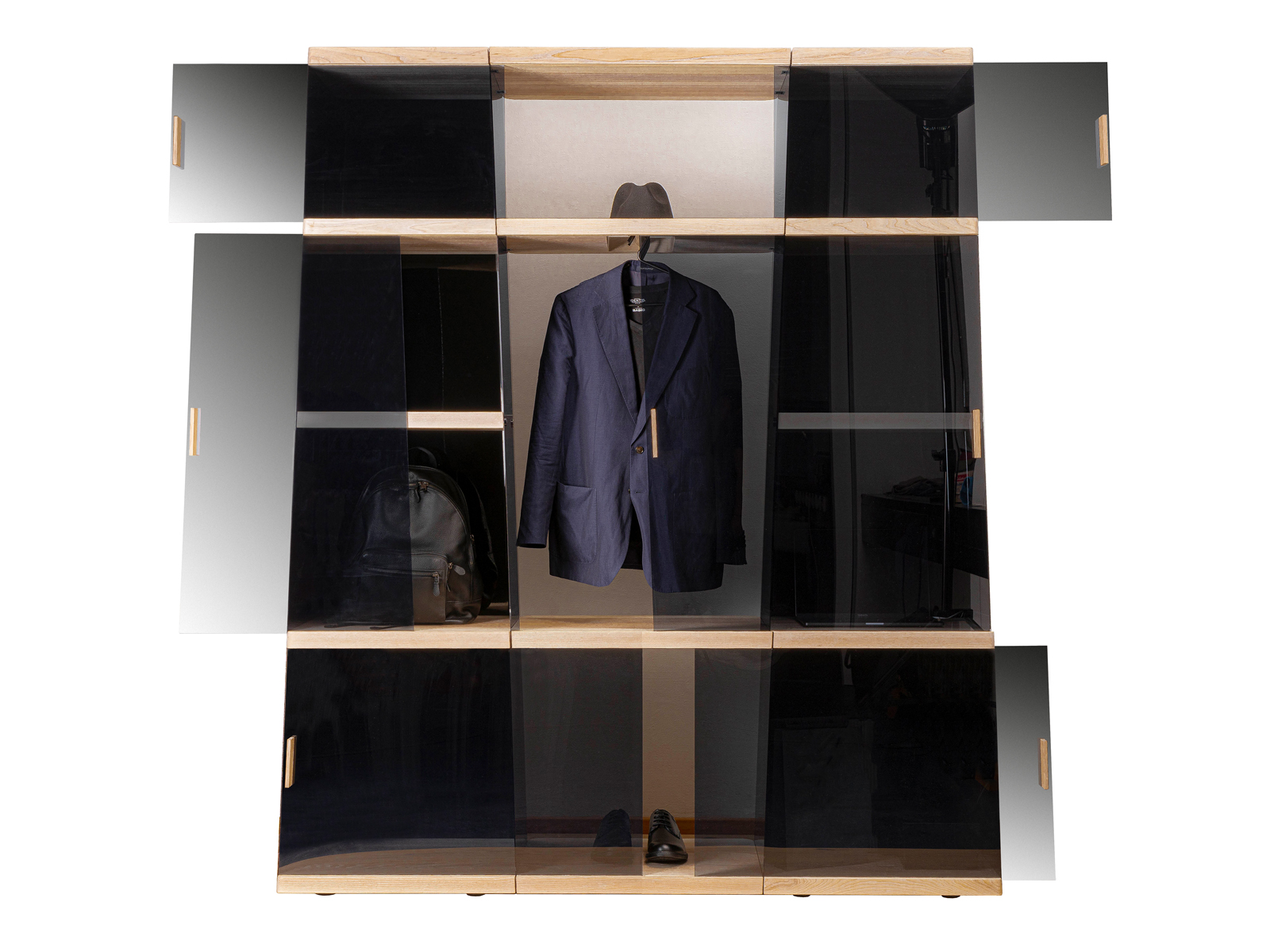
Metal-wood hybrid construction (Team Deschner/Hahlbohm/Niederlöhner/Utas) Edged aluminum frames form the structure, ash wood shelves the usable surfaces. The modules, which taper upwards, can be stacked to fit precisely and put together in a variety of combinations. Sliding glass doors and high-gloss lacquered metal surfaces give the system a high-quality appearance.
Rotating drawer system (Team Bott/Kuo/Rusch) Instead of side panels, rear panels and doors, a round bar braced between the floor and ceiling supports the entire system. Rotary drawers suspended from it create flexible, individual usage zones and offer different access options depending on their position. A specially developed adjustable swivel fitting solves the design challenge of the eccentric load.
Backbone system (Team Filipczyk/Lütke-Kappenberg/Volgger) The closet is reduced to a wall-mounted horizontal bar - the so-called "backbone". All other elements are either suspended downwards or placed on top. The system can be extended in stages and can grow with the user. Textile elements replace hard materials where appropriate.
Suitcase (Team Bähr/Cai/Krummradt/Will) Inspired by suitcases, a largely self-supporting plastic shell was developed whose ribbing simultaneously creates stability and serves as a support for flexible shelves. When opened, the furniture reveals all contents at a glance - without any drawers.
New hardware solutions In addition to the design innovations, completely new hardware solutions were also developed - such as a matt silver anodized aluminium clothes rail pull-out or a specially designed adjustable swivel fitting. These were consistently matched to the respective design and integrate seamlessly into the overall appearance.
Sustainability innovation All designs took the entire product life cycle into account. It was not just the choice of materials that was innovative, but the design principle itself: Joints without gluing, separability by type, reparability and the possibility of reassembly make sustainability the basis of the design - not an afterthought.
Transfer to the market The fact that two projects - "Wall-E" and "Suitcase" - were exhibited as functional prototypes at Interzum 2023 shows that the innovations developed were not just academic in nature, but have real industrial potential.
Sub-project lead
Project duration
2022-03-15 - 2022-07-31Project funding
Sustainable Development Goals