Additively Manufactured Polymer Human Proximal Femur Bone Models in Biomechanical Testing
| Doktorand / Doktorandin | M.Sc. Kevin Lippmann |
|---|---|
| Forschungsschwerpunkt | Produkte und Produktion |
| Zeitraum | 01.10.2022 - 31.12.2027 |
| Wissenschaftlich betreuende Person THRO | Prof. Dr.-Ing. Fabian Riß |
| Einrichtungen |
Fakultät für Ingenieurwissenschaften Zentrum für Forschung, Entwicklung und Transfer |
| Wissenschaftlich betreuende Person (extern) | Technische Universität München | Prof. Dr.-Ing. Veit Senner |
Biomechanical testing is essential for developing and evaluating implants, fixation systems, and surgical techniques for the human proximal femur. However, current testing approaches are limited by the availability, variability, cost, and ethical constraints of human cadaveric specimens, while commercially available artificial bone models often represent simplified or generic bone structures. This creates a methodological gap: there is a need for reproducible, anatomically meaningful, and mechanically relevant bone surrogates that can better represent the structural complexity and variability of the human proximal femur while remaining suitable for standardized laboratory testing.
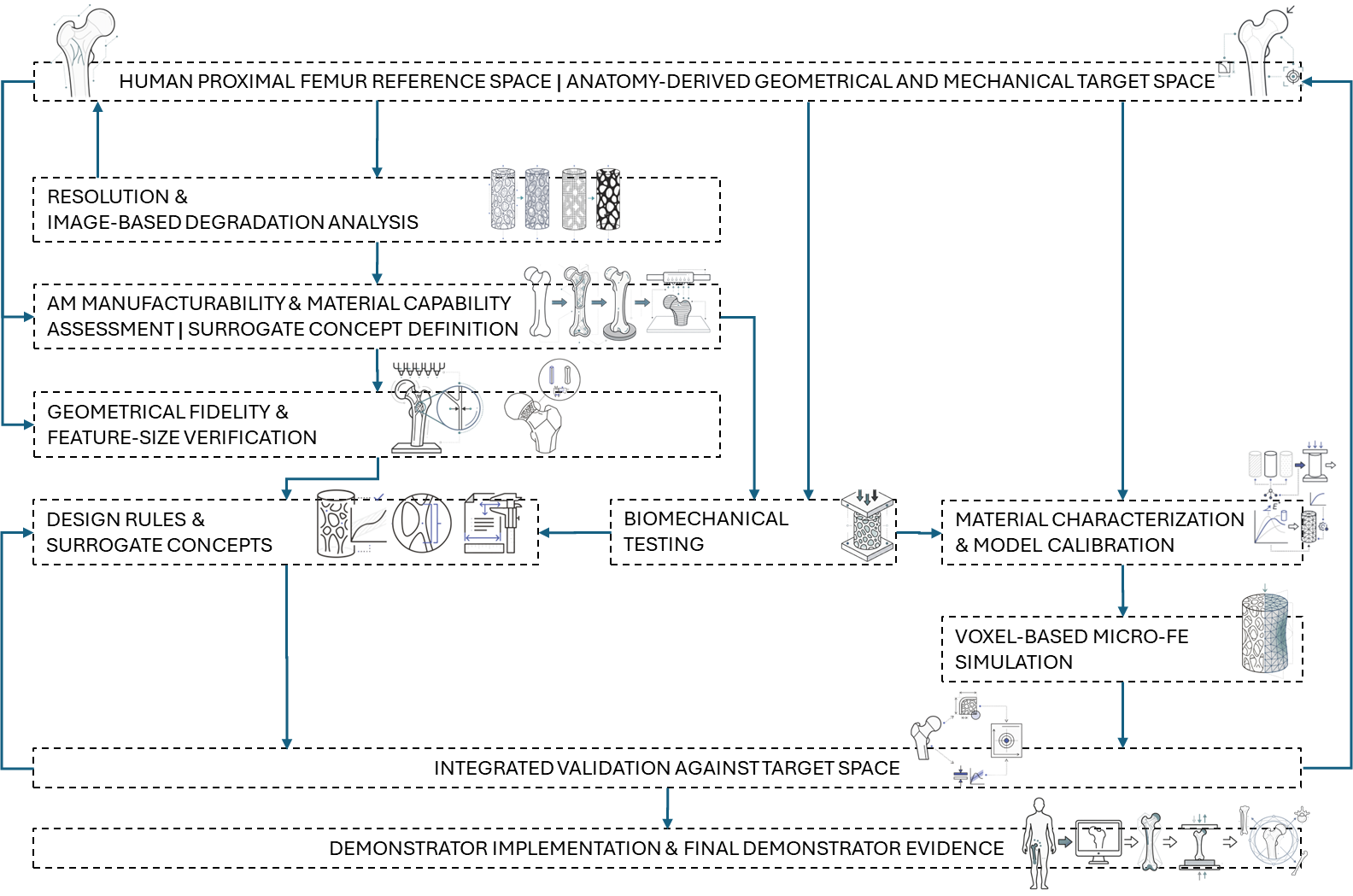
This dissertation investigates how polymer-based additive manufacturing can be used to develop human proximal femur bone models for biomechanical testing. The work focuses on translating anatomy-derived information into manufacturable and testable surrogate models. It defines biological, morphological, mechanical, and application-specific requirements for artificial proximal femur models and evaluates how far polymer AM technologies can reproduce these requirements. The overall contribution is a transferable methodological framework for the systematic development, assessment, and limitation-based validation of additively manufactured bone surrogates.
The dissertation combines literature-based target definition, image-based analysis of human proximal femur morphology, additive manufacturing process evaluation, and biomechanical validation. Human bone structures are characterized with respect to geometry, trabecular morphology, orientation, and mechanical relevance. These data are then translated into AM-compatible surrogate concepts and evaluated against process-specific manufacturing limits. Through demonstrator models, degradation studies, finite element analyses, and biomechanical testing, the work identifies which structural features can be reproduced reliably, where current polymer AM technologies reach their limits, and which design rules are required for future anatomically and mechanically informed bone models.